The Prediabetes Risk test

About the Prediabetes Risk Test

More than 84 million (1 in 3) American adults have prediabetes, a condition where blood sugar levels are higher than normal but not high enough yet to be diagnosed as type 2 diabetes. What’s more, nearly 90% percent of those people don’t know they have it. Having prediabetes greatly increases the chance of developing type 2 diabetes and other serious health conditions. It’s critical for Americans to learn their prediabetes risk, be screened regularly and take the steps necessary to delay or prevent type 2 diabetes.

The American Diabetes Association (ADA) launched its first risk test in 1993. The risk test was adapted by a published study and validated using data from the Centers for Disease Control and Prevention (CDC). To simplify the test, only health traits that people would know about themselves were included, such as age, height, and weight, but not blood sugar or cholesterol levels.

A person with a high score on the online risk test (five or higher) is at significant risk for having prediabetes. However, only a blood test can determine an official diagnosis.

Take the test to determine your risk for prediabetes here. 
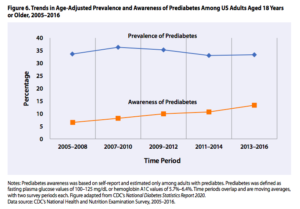
 

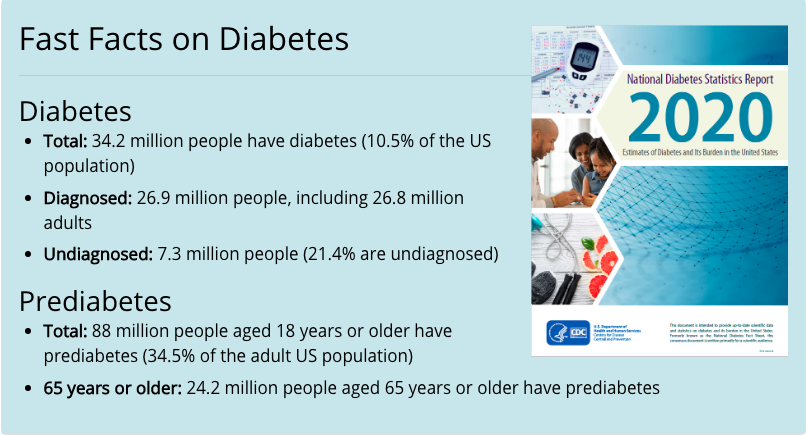
When a person has prediabetes, their blood sugar levels are higher than normal but not high enough for a diabetes diagnosis. Prediabetes can increase a person’s risk of developing type 2 diabetes, heart disease, and stroke. CDC estimates that 88 million, or 1 in 3, US adults aged 18 years or older had prediabetes in 2018. This number includes about 35 million adults aged 45 to 64 years and 24 million aged 65 years or older. Although an estimated one-third of US adults had prediabetes in 2018, only 15.3% were aware of it. Trends in the prevalence of prediabetes among US adults remained constant from 2005 to 2016. However, the percentage with prediabetes who had ever been told by a health care professional that they had prediabetes (awareness) has doubled (Figure 6) (CDC Diabetes Report Card, 2019).

If your prediabetes risk assessment comes out showing you have a high risk of getting diabetes, take action sooner than later. Even the smallest change in lifestyle habits, such as dietary changes, mild exercise, managing stress, and surrounding yourself with a strong support group can help you to continue to stay healthy. Contact us to reserve your spot in the next CDC Diabetes Prevention Program.
Enroll in a CDC certified Diabetes Prevention Program

Preventing Type 2 Diabetes 

Are you or someone you know at risk for Type 2 Diabetes? You can assess your risk level by taking this CDC quiz. 

Anisha at Functional Medicine Lifestyle now offers a Type 2 Diabetes prevention program, a program created and certified by the CDC. Not sure if this is the right program for you? Find out here why you should participate in a Type 2 Diabetes Prevention Program.  

Contact us today to find out when the next Diabetes Prevention Class is being offered! 

Diabetes is more common in the general population than you may think – based on the CDC’s 2020 National Diabetes Statistics report, 88 million people over the age of 18 have prediabetes. Diabetes is not necessarily always specific to one age group, race, lifestyle factors, or genetics. While some have higher risk factors, few are entirely immune to the disease. The CDC certified Diabetes Prevention Program can help you and your loved ones avoid the onset and complications of diabetes by educating yourself on risk factors, strategies to reduce your risk of becoming diabetic, and incorporating lifestyle changes. According to the studies done on the efficacy of the CDC’s Diabetes Prevention Program (DPP), “participants in the lifestyle intervention losing 5-7% of their bodyweight experienced a 58% lower incidence of type 2 diabetes than those who did not receive the lifestyle intervention”.

DPP programs can be offered in person or online to ensure increased access among vulnerable or rural populations. Some employers and insurance carriers cover the cost of these programs. Check with your employer or insurance carrier to see if they cover the cost of attending one of these programs.

Key components of the program include:

  • CDC-approved curriculum with lessons, handouts, and other resources to help you make healthy changes.
  • A lifestyle coach, specially trained to lead the program, to help you learn new skills, encourage you to set and meet goals, and keep you motivated. The coach will also facilitate discussions and help make the program fun and engaging.
  • A support group of people with similar goals and challenges. Together, you can share ideas, celebrate successes, and work to overcome obstacles. In some programs, the participants stay in touch with each other during the week. It may be easier to make changes when you’re working as a group than doing it on your own


Additional Diabetes Resources:

  • The United States Diabetes Surveillance System is an interactive web application that provides national, state, and county diabetes data. Users can view the data in the form of customized maps, charts, or tables on desktop and mobile devices.
  • The Healthy People 2020 Diabetes website provides information about diabetes-specific objectives and recommended practices as part of the nation’s 10-year health agenda.
  • The National Diabetes Statistics Report is a CDC publication that provides updated statistics about diabetes in the United States for a scientific audience.

Educate Yourself: Cannabis as Medicine

Cannabis for medical use is a frequent question from patients. Cannabis is most often medically used for patients undergoing chemotherapy or suffering from HIV. A certain type of THC was approved for nausea and vomiting for chemotherapy patients in 1986 and it is widely used by oncologists for this purpose. THC was also approved for anorexia for HIV patients; however, some data showed it was less effective. The U.S. Food and Drug Administration (FDA) has approved synthetic THC-based medications, and research is currently underway about the long term effects.

A cannabis plant contains 400 chemical compounds and there are 70-120 chemicals and 21 carbons that have many medicinal properties. The plant is a rich source of compounds that can benefit patients in different ways. A lot of research in cannabis has been studied over the years in animals. This page is for educational purposes only. Please check the National Institute on Drug Abuse’s website on Marijuana as Medicine.


History: Cannabis was originally discovered in China, and then brought to India, making its way to the Arab world and eventually to the Western world. A surgeon in the UK brought cannabis to Queen Elizabeth to relieve her menstrual cramps and then brought it to the United States in 1937 for doctors to try on patients. The medical community has wanted to study cannabis for medical use since 1937 but the government has always opposed it and continued to classify as a schedule 1 drug for abuse. Opioid drugs are considered schedule 2 drugs.

       So why do we have the endocannabinoid (ECS) and cannabinoid receptors? They help us forget what we just did a couple of minutes ago so that you can be “here and now” and “focus” on being present. The ECS acts as a messenger, giving your body specific directions on what to do in your brain, spinal cord, cells and in your day to day functions. It also helps us forget pain. So the overall effect of the CB1 receptor activation is the suppression of neurotransmitter release. These cell receptors act as messengers, giving our body signals from various organs in the body. ECS attacks certain enzymes in your body and makes you sick. Cannabis, like CBD, can attack these enzymes and regulate your ECS to help you feel good and create balance in the body known as homeostasis, creating a therapeutic condition for certain symptoms

      CBD Cannabidiol: Cannabidiol, also known as CBD, is found in the cannabis plant. Over 100 cannabinoids are found in this plant, including hemp and marijuana. However, CBD comes only from hemp, a plant that has been used in many cultures in food, and it does not have psychoactive effects, thus there is no “high”. Research is ongoing on the potential use of topical and oral CBD oil, which does not have THC and therefore no psychoactive effects, making it a potentially safer alternative in this respect.
CBD is not as potent as THC. The CBD to THC ratio has never been studied in humans, only in animals. It seems to relieve anxiety and helps people sleep. But, it cannot do that without having some psychoactivity in the brain. Research has shown that it is not intoxicating but it can be psychoactive and create euphoria in some people depending on how that person’s CB1 receptor is reacting. CBD capsules are considered schedule 1-abusive category by NIDA – the government that rules the Cannabis use. But since medical marijuana products are still not subject to the same federal safety regulations that govern pharmaceuticals, there is no guarantee that CBD oils are accurately labeled or do not contain contaminants; also, with such products, it may not be possible for a patient or their caregivers to accurately control the dosage or even know what dosage is being administered per NIDA. Therefore, the quality depends on how it was planted and developed.

       Cancer/HIV patient use: A certain type of THC was approved for nausea and vomiting for chemotherapy patients in 1986 and it is widely used by oncologists for this purpose. THC was also approved for anorexia for HIV patients; however, the data indicates it may not be as helpful. The U.S. Food and Drug Administration (FDA) has approved THC-based medications, prescribed in pill form for the treatment of nausea in patients undergoing chemotherapy and to stimulate appetite in patients with wasting syndrome due to AIDS. The FDA also approved a CBD-based liquid medication called Epidiolex® for the treatment of two forms of severe childhood epilepsy, Dravet syndrome, and Lennox-Gastaut syndrome. Animal studies showed that THC in animals reduced cancer but it is not approved for human use by the government that controls the cannabis use for medicine-NIDA. The government is still exploring other uses of CBD, THC, and other cannabinoids for medical treatment.
For updates, PLEASE VISIT NIDA
-Source: “Cannabis as medicine” by Dr. Donald Abraham, Oncologist, UCSF (2016)

Calculate BMI-Body, Mass, Index

The following information is for education purposes only. If you fall in the high or low BMI or WC range, please contact your physician to discuss your concerns. The medical provider is the right person to advise you on the next steps. Awareness is the key to the healthy body. 

Body mass index (BMI) is an approximate measure of your best weight for health. It is calculated by dividing your weight in kilograms by your height in meters squared (m2).

BMI is intended for adults only, as children and adolescents are constantly growing. This makes it difficult to have set values for BMI cut-offs for young people. However, in adults who have stopped growing, an increase in BMI is usually caused by an increase in body fat. You can calculate your BMI using the CDC Adult BMI calculator here.

Your BMI will classify you as ‘underweight’, ‘healthy weight’, ‘overweight’ or ‘obese’, as defined by the World Health Organization. If your BMI is:

  • under 18.5kg/m2 – you are considered underweight and possibly malnourished
  • 18.5 to 24.9kg/m2 – you are within a healthy weight range for young and middle-aged adults
  • 25.0 to 29.9kg/m2 – you are considered overweight
  • over 30kg/m2 – you are considered obese.

Risks of being overweight (high BMI) and physically inactive

If you are overweight (with a BMI over 25kg/m2) and physically inactive, you may develop:

  • cardiovascular (heart and blood circulation) disease
  • gallbladder disease
  • high blood pressure (hypertension)
  • type 2 diabetes
  • osteoarthritis
  • certain types of cancer, such as colon and breast cancer
  • depression and other mental health disorders.

Risks of being underweight (low BMI)

If you are underweight (BMI less than 18.5kg/m2), you may be malnourished and develop:

  • compromised immune function
  • respiratory disease
  • digestive diseases
  • cancer
  • osteoporosis.

Imp: BMI calculations will overestimate the amount of body fat for:

  • body builders
  • some high-performance athletes
  • pregnant women.

IMP: BMI calculations will underestimate the amount of body fat for:

  • the elderly
  • people with a physical disability, who are unable to walk and may have muscle wasting.

BMI is also not an accurate indicator for people with:

  • eating disorders like anorexia nervosa
  • extreme obesity.

Waist circumference is a better indicator of increased disease risk

Waist circumference can be used to indicate health risk for chronic diseases.

For men:

  • 94 cm or more – increased risk
  • 102 cm or more – substantially increased risk.

For women:

  • 80 cm or more – increased risk
  • 88 cm or more – substantially increased risk.

Although the tendency to deposit fat around the middle is influenced by a person’s genes, you can still take this genetic tendency into account and do something about it.

Being physically active, avoiding smoking, and eating unsaturated fat instead of saturated fat have been shown to decrease the risk of developing abdominal obesity.

Source: Better Health

Should you choose to go Lectin Free?

This post comes from Nutritional Twins.com

If you’re like our friends and our clients, you’re wondering if cutting out lectins from your diet will help you with weight loss and make you healthier, or if it’s just another fad diet.  If you’re thinking about trying it, here’s the scoop, including what foods to eat on a lectin-free diet as well as which foods are highest in lectins.

What exactly is the lectin free diet? And what is the thinking behind cutting out foods with lectins?

Lectins are a type of protein that exist in most plants and in dairy foods.  In plants, lectins protect the plant as they grow from bugs and insects. Lectins are highest in foods like nightshade vegetables (bell peppers, tomatoes, eggplant, potatoes, cayenne and chili pepper), legumes, grains, nuts and dairy products.  The goal of the lectin-free diet is to cut back or completely eliminate lectins from your diet.  Lectins have both good and bad properties when it comes to health, and although the lectin-free diet is controversial and more research is needed, the diet is super trendy and that’s why everyone has been asking us about it.  It was developed by a cardiologist named Steven Gundry who feels that cutting back on lectins and taking the supplements that he sells will improve health and help with weight loss.

Find out more about this recipe